
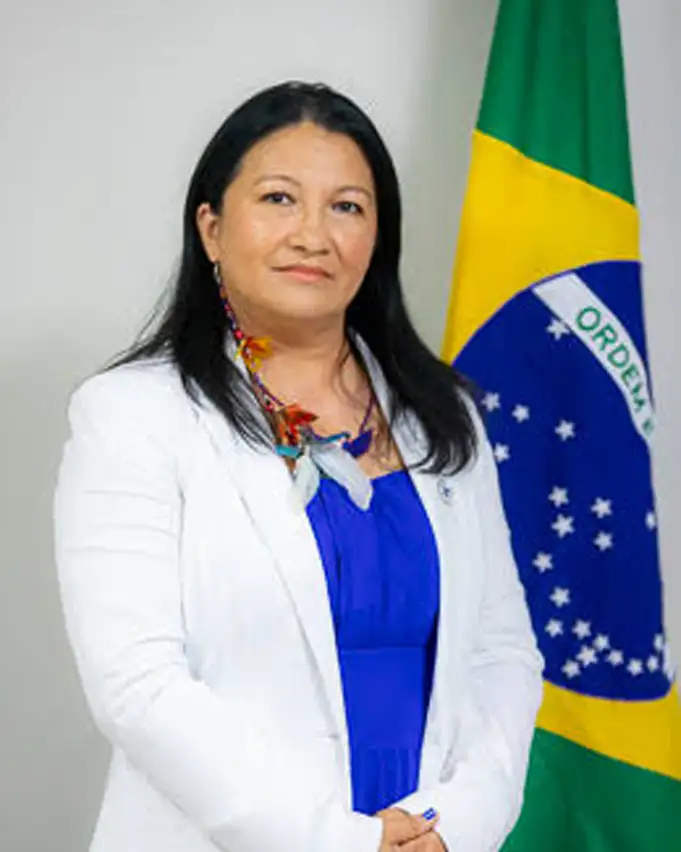
Eliene Rodrigues Putira Sacuena
Eliene Rodrigues Putira Sacuena is an Indigenous woman of the Baré people and Deputy Director of the Special Secretariat of Indigenous Health at the Ministry of Health (Brazil). She earned her undergraduate degree in Biomedicine from Universidade Federal do Pará (UFPA), and her master and doctoral degrees in Bioanthropology from UFPA. She has experience in the field of Genetics, with an emphasis on Human and Medical Genetics, working primarily on the following topics: collective health, public health, and Indigenous health. She is a collaborating professor at the UFPA Faculty of Psychology.
Saúde Indígena: Com o Caderno e a Caneta na Mão Trazendo os Determinantes Sociais, Epidemiologia, Genética/Ancestralidades e os Povos Indígenas na Pandemia da COVID-19
This conference aims to investigate the approach on genetic factors that may have contributed to the milder clinical outcomes of COVID-19 in Brazilian indigenous populations. 263 Indigenous from the Arawet´e, Kararao, ˆ Parakan˜ a, Xikrin do Bacaj´ a, Kayapo ´ and Munduruku peoples were analyzed, 55.2% women, ages ranging from 10 to 95 years (average 49.5 ± 20.7). Variants in genes involved in the entry of SARS-CoV-2 into the host cell (ACE1 rs1799752 I/D, ACE2 rs2285666 C/T, ACE2 rs73635825 A/G and TMPRSS2 rs123297605 C/T), were genotyped in indigenous peoples from the Brazilian Amazon, treated during the SARS-CoV-2 pandemic between 2020 and 2021. The distribution of genotypes did not show any association with the presence or absence of IgG antibodies. Additionally, the influence of genetic variations on the severity of the disease was not examined extensively because a significant number of indigenous individuals experienced the disease with either mild symptoms or no symptoms. It is worth noting that the frequencies of risk alleles were found to be lower in Indigenous populations compared to both continental populations and Brazilians. Indigenous Brazilian Amazon people exhibited an ethnic-specific genetic profile that may be associated with a milder disease, which could explain the unexpected response they demonstrated to COVID-19, being less impacted than Brazilians.