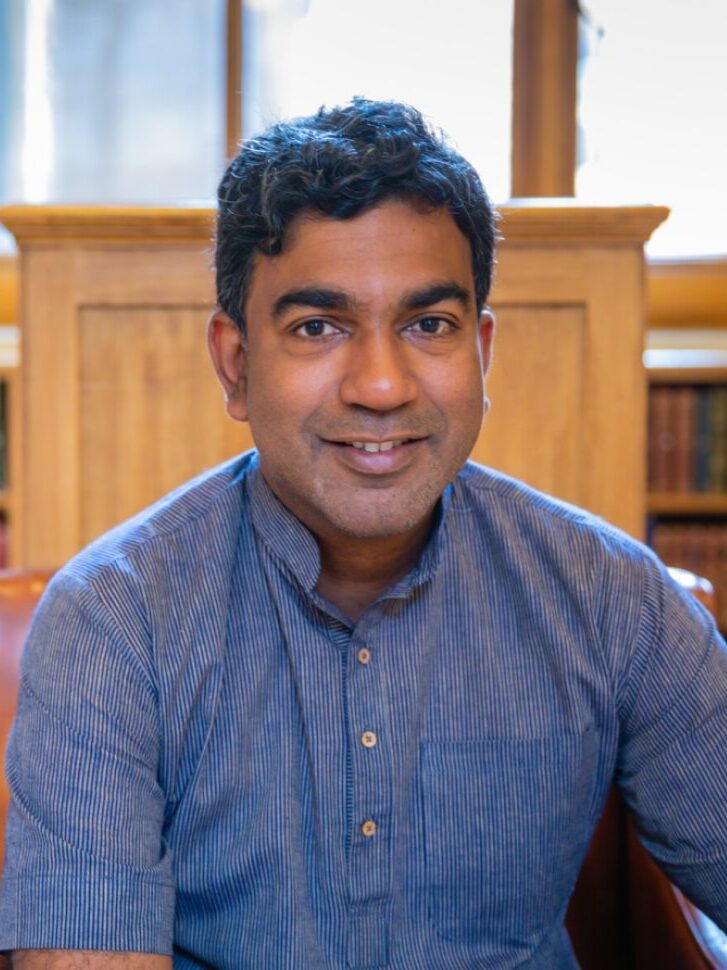
Sujit Sivasundarum
Sujit Sivasundarum is Professor of World History and Fellow, Gonville and Caius College. His research focuses on world history, particularly the eighteenth and nineteenth centuries, although his more recent work has expanded well beyond these periods. He began his academic career as a Research Fellow in History at Gonville and Caius College, University of Cambridge, in 2001. He subsequently served as a College Teaching Officer at the college, supervising across the range of world history papers. He then took up a Lectureship in South Asian History at the London School of Economics. He returned to the University of Cambridge in 2010 and was appointed Professor of World History in 2019....
Sujit Sivasundarum
Mini BioSujit Sivasundarum is Professor of World History and Fellow, Gonville and Caius College. His research focuses on world history, particularly the eighteenth and nineteenth centuries, although his more recent work has expanded well beyond these periods.
He began his academic career as a Research Fellow in History at Gonville and Caius College, University of Cambridge, in 2001. He subsequently served as a College Teaching Officer at the college, supervising across the range of world history papers. He then took up a Lectureship in South Asian History at the London School of Economics. He returned to the University of Cambridge in 2010 and was appointed Professor of World History in 2019. He has also served as Director of the University's Centre of South Asian Studies.
Throughout his career, he has held visiting fellowships in Paris, Singapore, Munich, and Sydney. From 2015 to 2017, he was the Sackler Caird Fellow at the National Maritime Museum in Greenwich. In 2012, he was awarded the Philip Leverhulme Prize for History, and in 2023, he was elected a Fellow of the British Academy.
His graduate training was in the History and Philosophy of Science. His research now engages with imperial history, the history of science, environmental history, cultural history, the history of race, Indian Ocean history, and Pacific Ocean history.
His distinguished lectures include the Royal Historical Society's Prothero Lecture (2019), the University of Edinburgh's Fennell Lecture (2018), the Innes Lecture in Norwich (2025), the Stenton Lecture at the University of Reading (2025), and the Mossman Lecture at McGill University, Canada (2026). In addition, his 2022 keynote lecture, delivered at the University of Jaffna in northern Sri Lanka to mark one hundred years of the humanities and social sciences, is available online.
The Indian Ocean and Environmental Fragments
The Indian Ocean's history brings together the richest diversity of human exchanges, migrations, and cultural patterns. Though it trails behind the other two major oceans by way of its size, it is estimated that around one third of the global population lives facing this vast sea. In order to provide some new insights into the environmental history of this busy maritime highway, this lecture works from history, outwards to other disciplines. It also concentrates on various environmental 'bits and pieces', which I call fragmentary or elemental, in order to think through how humans and material from nature, including various species, interacted across this sea over the long-term. Here I focus on four of the 'bits and pieces' that I'm currently working on: coir rope, cowrie shell, ambergris and sea cucumber. Their persistence over the long-term despite their smallness or slipperiness; their durability when worked up and cast as technique in human hands; their ability to build up to structures like exploration, religiosity, capitalism, imperialism or globalisation; the way in which they create material composites and symbolic associations with other materials but also critically here in what I will say with the human frame itself; all of this means that there is a case for further scrutiny of this class of stuff which is often misplaced in historical narration.