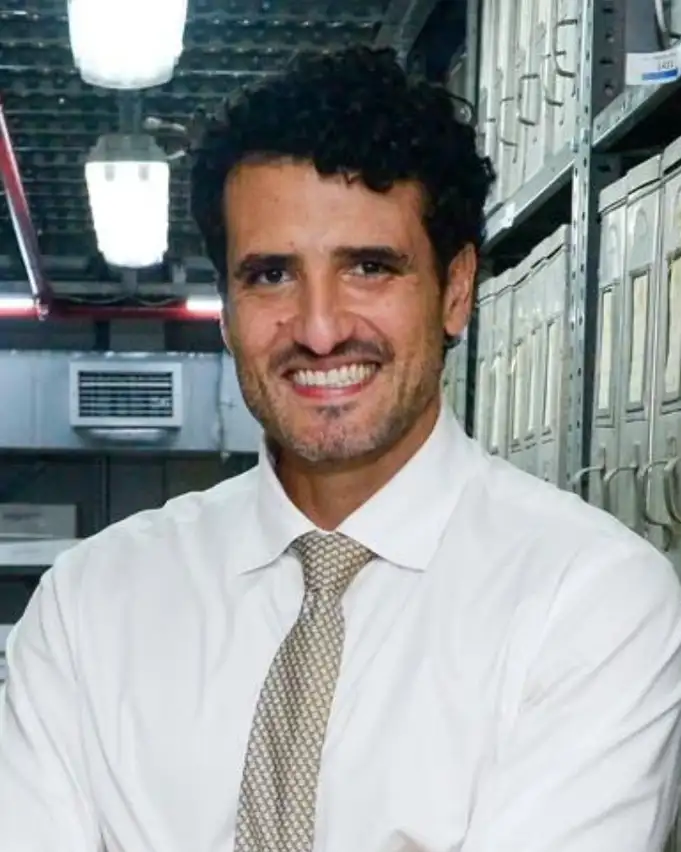
Thiago Lima Nicodemo
Thiago Lima Nicodemo is the undersecretary responsible for the Public Archive of the State of São Paulo, an associate professor (livre-docente) of Theory of History at Unicamp, and head of the Center for Digital Humanities at IFCH-Unicamp (https://www.chd.ifch.unicamp.br). He chaired the State Commission for Access to Information (CEAI) between 2021 and 2023 and has served as its executive secretary since 2024. He is also the technical lead for the Digital Memorial of the Covid-19 Pandemic, an initiative of the Pan American Health Organization (PAHO) and the Ministry of Health (https://memorialdigitalcovid19.org.br). With a degree in History from USP and in Law from PUC-SP, he holds a...
Thiago Lima Nicodemo
Mini BioThiago Lima Nicodemo is the undersecretary responsible for the Public Archive of the State of São Paulo, an associate professor (livre-docente) of Theory of History at Unicamp, and head of the Center for Digital Humanities at IFCH-Unicamp (https://www.chd.ifch.unicamp.br). He chaired the State Commission for Access to Information (CEAI) between 2021 and 2023 and has served as its executive secretary since 2024. He is also the technical lead for the Digital Memorial of the Covid-19 Pandemic, an initiative of the Pan American Health Organization (PAHO) and the Ministry of Health (https://memorialdigitalcovid19.org.br).
With a degree in History from USP and in Law from PUC-SP, he holds a master's and a doctorate in Social History from USP. He completed two post-doctoral fellowships at the Institute of Brazilian Studies at USP (Fapesp, 2012 and 2014) and obtained his livre-docência degree from Unicamp (2025). He was a researcher at the Freie Universität Berlin as an Alexander von Humboldt Foundation fellow in the experienced researcher category (2017-2020). He has served as a researcher or professor at Adam Mickiewicz University in Poznań (2019), Stony Brook University (2015), the Oliveira Lima Library/The Catholic University of America (2014), the University of Texas at Austin (2009-2010), and the University of Bologna (2007). He is the author of Urdidura do vivido (Edusp, 2008) and Alegoria moderna (Unifesp, 2014), and co-author, with Pedro A. C. dos Santos and Mateus Pereira, of Uma introdução à história da historiografia brasileira, 1870-1970 (FGV, 2018). Together with the same co-authors and through the same publisher, he is currently publishing Eurocentrismo e história: ensaio sobre a historiografia do século XXI.
In the Government of the State of São Paulo since January 2021, he is responsible for the state policy on document management. This encompasses the SEI.sp, SEI Cidades, and Documentos Digitais systems of the SP Sem Papel program, as well as Despapeliza.SP, all aimed at digital transformation and the streamlining of public administration. He currently leads the implementation of the State Digital Preservation Policy and a public repository for digitized and born-digital documents and data.
The Humanity of the Machine: Sovereignty, Responsibility, and Education in the Digital Humanities
Debates on artificial intelligence usually ask what the technology does to the humanities; this talk asks what the humanities can bring to the machine, and to the training of those who will build and govern it. Rather than defending their specificity, it seeks the ground the humanities share with other disciplines and with code itself, read as a historical artifact. Three questions follow: sovereignty, or who controls the infrastructure, data and archives on which AI and public memory depend; responsibility, or how historical method, provenance and critique can keep AI-assisted knowledge accountable; and formation, or what the humanities should bring to AI curricula, so that future professionals can understand and shape these tools, not merely use them.